
Peranakan food is the cuisine of the Peranakan people, descendants of Chinese traders who settled in the Malay Archipelago and married into local Malay and Indonesian communities. Also known as Nyonya food, it blends Chinese ingredients and techniques with Southeast Asian spices, coconut milk, tamarind and chilli. You will find Peranakan food in Malaysia, Singapore and across Indonesia, especially along the north coast of Java.
What is Peranakan food?
The word Peranakan roughly means "locally born." From the 15th century onwards, Chinese merchants settled in trading ports such as Malacca, Penang, Semarang and Lasem, and their families developed a culture that was neither fully Chinese nor fully local.
Peranakan food is the most delicious expression of that mix. Women of the community, called Nyonya, were the keepers of the kitchen, which is why Peranakan cuisine is also called Nyonya food. Recipes were passed down through families and often took hours or even days to prepare.
Peranakan food in Indonesia
In Indonesia, Peranakan food is part of everyday life, even if many people do not call it by that name. Chinese Indonesian communities in Semarang, Lasem, Surabaya, Jakarta and Medan shaped dishes that are now national favourites, from lumpia and bakmi to lontong cap go meh.
Indonesian Peranakan food often leans on local ingredients such as keluak, candlenut, galangal and sweet soy sauce. Learn more about these Indonesian spices and how they are used.
Key flavours of Nyonya food
- Rempah: spice pastes of shallots, chilli, galangal, lemongrass, turmeric and candlenut, pounded and slowly fried
- Sour and tangy: tamarind and calamansi lime to balance richness
- Coconut: coconut milk in curries and desserts, and grated coconut in kuih
- Fermented flavours: shrimp paste, fermented soybean and keluak
- Chinese techniques: braising, steaming and stir-frying
10 Peranakan food classics to try
1. Ayam buah keluak
Perhaps the most iconic Peranakan dish, ayam buah keluak is chicken braised in a tamarind and spice gravy with keluak nuts. The nut flesh is scooped out, mixed with spices and stuffed back into the shell. Its earthy, almost chocolatey flavour is unforgettable.
2. Laksa
Laksa is a noodle soup with many regional versions. Nyonya laksa is rich with coconut milk and spice paste, topped with prawns, egg and fresh herbs.
3. Babi pongteh
Pork belly braised slowly with fermented soybean paste, palm sugar and shallots until tender and glossy. It is a Peranakan favourite for family gatherings.
4. Lontong cap go meh
A Chinese Indonesian Peranakan dish from Java, traditionally eaten on the fifteenth day of Chinese New Year. Rice cakes are served with chicken curry, vegetables in coconut milk, egg and crunchy toppings.
5. Lumpia Semarang
Semarang's famous spring rolls are filled with bamboo shoots, egg and prawn or chicken, and served with a sweet, garlicky sauce and fresh spring onion.
6. Chap chye
A comforting stew of cabbage, glass noodles, mushrooms, lily buds and dried shrimp, braised in a savoury fermented soybean sauce.
7. Otak-otak
Spiced fish paste wrapped in banana leaf and grilled. The Nyonya version is rich with coconut milk and rempah.
8. Sambal belacan
No Peranakan meal is complete without sambal belacan: fresh chilli pounded with toasted shrimp paste and finished with lime.
9. Nyonya kuih
Kuih are bite-sized cakes, often coloured with pandan or butterfly pea flower. Favourites include kuih lapis, a steamed layered cake, and onde-onde, pandan balls filled with palm sugar.
10. Pindang bandeng
A milkfish dish in a spiced, tangy broth, popular among Chinese Indonesian families in Semarang, especially around Chinese New Year.
Where to try Peranakan food in Bali
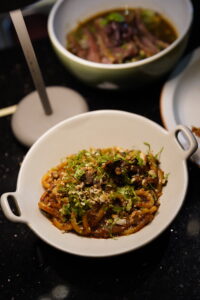
Bali has a long history of Chinese settlement, and Chinese Indonesian influences show up in many local dishes and markets. For a modern take on the flavours of the archipelago, visit Spice by Blake on Jalan Monkey Forest in central Ubud.
Led by Chef Blake Thornley, chef and co-owner of Mozaic, Spice reinterprets dishes from across Indonesia with fine dining technique and local ingredients, and has hosted Peranakan-inspired dinners that celebrate this heritage. Its regular menu includes wagyu beef rendang and brisket rawon, the latter made with keluak, the same nut at the heart of ayam buah keluak.
[Optional teaser: Peranakan Table, February 2027]
For a full tour of Indonesian flavours, order Feed Me: eight dishes across four courses, chosen by the kitchen and shared by the whole table, for IDR 388,000++ per person. You can also explore our guides to Indonesian dishes to try and Indonesian street food.
Frequently asked questions
What is Peranakan food? Peranakan food is the cuisine of the Peranakan Chinese communities of Malaysia, Singapore and Indonesia. It combines Chinese cooking with local spices, coconut milk, tamarind and chilli.
Is Peranakan food the same as Nyonya food? Yes. Nyonya food is another name for Peranakan food, named after the Nyonya, the women who cooked and passed down the recipes.
What is the most famous Peranakan food? Ayam buah keluak, Nyonya laksa, babi pongteh and Nyonya kuih are among the most famous Peranakan dishes.
Is there Peranakan food in Indonesia? Yes. Chinese Indonesian Peranakan food is especially strong in Semarang, Lasem, Surabaya, Jakarta and Medan, with dishes such as lontong cap go meh, lumpia Semarang and pindang bandeng.
Is Peranakan food spicy? Often, but it is about balance more than heat. Spice pastes, sourness from tamarind and richness from coconut all play a part, with sambal on the side for extra kick.
Taste the archipelago in Ubud
Peranakan food shows how Indonesian cooking has always absorbed new influences and made them its own. Explore that spirit in modern Indonesian dishes at Spice by Blake, Jalan Monkey Forest, Ubud.
